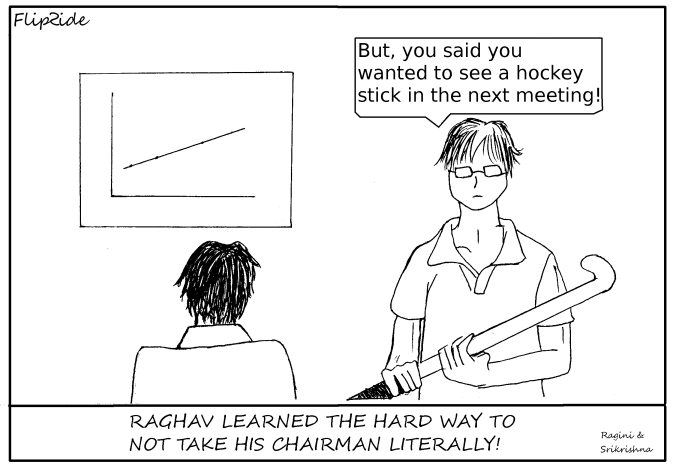
 As we set out to raise money – we learn a whole new vocabulary. Can you say “hockey stick?”
Month: June 2013
 “The VCR is not turning on!” says my wife over the phone. We often have short phone calls along these lines. At other times it’s the laser printer or the washing machine not working or turning on. My first question usually is “Honey, is it plugged in the wall?” followed by “Is the switch on the wall socket turned on?” Sometimes we find that the kids have used the electrical socket for something else and just unplugged our device. At other times they left the outlet turned off or forgotten to turn the UPS back on, after switching it off when it last squealed.
While I’m sure your spouse (or room mate or sibling) and you never have such conversations, we certainly have to thank William of Occam (also Ockham) who lived eight hundred years ago. His eponymous maxim (aka Occam’s razor) states “in explaining a thing no more assumptions should be made than are necessary.”
In other words the simplest explanation for any observed phenomenon is likely the right one. This is the reason when we show up with chest pains, they check for heartburn or gas first rather than rush you into surgery. As entrepreneurs, managers and leaders, we are often faced with issues that seem to baffle us.
- Why can’t I seem to hire anyone?
- Why didn’t that VC call us back – the meeting went so well, we thought?
- Why is the customer not prepared to commit?
- Why is the network slow?
- Why does our product crash often?
For most of theses instances, Occam’s razor is worth keeping in mind. Before you explore more complex reasons, look for the simplest ones first and those are the most likely ones.
Of course it’s worth keeping Einstein’s caveat in mind
“Everything should be made as simple as possible, but not simpler.”
If you’ve come this far, you might as well read what physicists have to say about Occam’s razor here.


My daughter and I began doing a business cartoon back in 2011for the Hindu Business Line. Given father’s day I thought this might be a good one to share. I’ll try to share one each week.
 A question posted in the HeadStart Forum once again reminded me of how easy many of us find it to build the product first before figuring out how best to get customers. Having bootstrapped two startups and mentored several more, here are three tips on bagging the first (new) customer.
Your ex-employer if you’ve worked before you started up on your own, your ex-employer & ex-colleagues are the best place to start. They know you, hopefully don’t dislike you & you know how much money they have. They also likely can give you honest, even if not favorable, feedback on your product or service. Other than your mother, this is likely the most friendly reception you might get from a prospective customer.
Your ex-employer’s customers This is how I got my first break – when my employer turned down a customer who was deemed too small. I approached them with a request to be able to address their requirement and was given the go-ahead. This let me take the PO, a 30% advance and then start my first company, with a customer and cash in hand. Don’t hesitate to ask and don’t be surprised if your ex-employer and their customers are amenable to such an arrangement – as everyone prefers to deal with a known quantity.
Reference customer Visualize who’d be your ideal customer and more importantly the customer for whom your solution would be ideal. Strike a deal – such as a free trial or finite number of units or one [week | month | year] of free product or service – whichever make sense depending on what your offering is – in return for a strong endorsement or further references. So if Amazon India or Procter & Gamble or some other name brand or market/channel leader is prepared to endorse your product or service, it can open the flood gates to more customers. This requires you to be able to articulate your value clearly to your prospective customer and explicitly asking them for a reference.
Of course as with looking for a job or in the Indian context, looking to get married, it’s a good idea to let everyone you know, that you are looking for customers. So trade shows, your website, entrepreneur community forums, family weddings are all fair game to chase customers. While this is more likely to result in business cards and contacts, it will be ripe for the picking once you have that first customer. Happy hunting!
 As an entrepreneur, you’ll find yourself having to negotiate almost as much as you have to sell. From landlords, to suppliers, prospective employees, partners and of course customers – you’ll negotiate often without even recognizing that’s what you are doing. While there are entire books written on the subject of negotiation, a few simple rules have served me well over the years.
Be clear about what you want Simple as it sounds, often we get carried away or worse yet upset and take a position or ask for something, which is really not what we want. Sometimes it’s as simple as that we were not clear going into a negotiation as to what it is we want. So when we actually get what we demanded and find that we are not happy, it’s not a good place to be – especially if you’ve burned bridges or needlessly cheesed off folks you’d have to work with. So don’t go into any negotiations without clarity on what you want – be it bringing on board a new employee, signing a new customer, re-working the terms of a loan or selling your company.
Know you walk-away price Be clear when you would not do a deal – this has to be black and white to yourself and can’t have any ifs or buts. And this need not be just about money, could easily be about the other terms. For instance, if you are selling your company and the buyer is not prepared to give the terms that you want for your team (for instance, employment guarantees or restricted stock) — a situation I’ve faced —you need to know are you prepared to walk away. Being clear about this makes the entire negotiation far less stressful.
Never negotiate against yourself This is by far the most common error all of us commit. We’ve all experienced it. Like when you see a jacket you like at a store – you ask for the price and find it too high. So you walk away – the shopkeeper calls after you – saying he’ll knock of 20% – he’s just negotiated against himself (of course he may have marked it up 40% 🙂 Particularly when negotiating a contract with a prospective customer, the temptation is great to lower our price or improve our terms when the customer feels we are not offering a good deal. Instead, it’s always best to ask the customer to counter your offer – let them quote a price that’s agreeable to them or terms that are more palatable. Now you have something to negotiate about – maybe you get nearer their price, but take something off the table (support, warranty, options) or you can counter with a different price for better payment terms. The important thing is that there’s got to be give and take and until the party puts a stake in the ground, don’t move yours.
Bring something to the table that you can concede All of us like a good deal – especially one that is done in a spirit of give and take. Just as we expect the other guy or gal to make concessions be prepared to make some of your own. This requires you not only to know what you want and what your walk away is, but what is NOT important to you. For instance, if you’re trying to close a large deal and having money up front is not critical for you, be prepared to give that up – the important thing is to ask for a thing or two, that you know you are prepared to concede and be clear which those are and which ones are non-negotiable. If everything is non-negotiable you are not going to get too far. And it makes the whole negotiation less than pleasant.
Save your best for the last Despite much advice against it, some folks and entire cultures conduct negotiations on a piecemeal basis – that is one item at a time. You discuss one point, make concessions and then they make their next demand. Refuse to do this politely. And the best way I’ve found to do this is what I term, saving your best for the last. In essence, establish what’s the critical care about for the other party (and yourself). Ask them, if we close on this item (whichever one it is) is there anything else that’s holding the deal back. If the answer is no, close on the other times. If they answer is yes, get down to negotiating to a close. If they pop something else up after this they are not dealing in good faith. Be prepared to walk.
Related articles


Recent Comments