The Entrepreneur Life

Month: December 2013

How much money should you raise?

An example of a cheque.

The best answer to this question, as you’d probably guess is “Depends!”

The most common answer I hear is, “As much as you can” – which I’m not sure is the right answer, for at least two reasons. If you raise far more than you actually require,

  • you’ll be diluting more of your company at a price lower than you need to
  • you run the risk of developing a wide range of bad habits starting with mistaking raising money with running a successful business

Entrepreneurship literature suggests too much money can be as much (or greater) a cause for business failure as not enough money. Of course the same literature suggests that under-capitalization is the primary cause of slow to no growth of startups.

Better minds than mine have grappled with this issue, in a variety of manners. However most of them are set in the context of the US of A.  I provide links to several at the end of this post.

Whether you raise money, in what manner and how much will depend on

Nature of business – is it a service business, that is better boot-strapped? Web design, IT services, most consulting businesses all fall into this category. Does it require significant capital expenditure or up front investment – multi-location courier service or restaurant, manufacturing or high tech businesses fall into this latter category. Of course a slew of businesses fall in between these two – which would put them in the sweet spot for formal fund raising.

Nature of capital – are only friends, family or fools going to fund your business – most businesses would fall into this category – particularly service businesses that are going to stay small or local.  If you are already profitable or revenue making and are looking for capital to grow, you’re likely better off with debt. Of course in the Indian context debt may be non-trivial to access, despite a pile of money being available. Or do you need equity capital – as offered by angels or venture capitalists?

Assuming that you are a fundable business, I’d suggest asking the following three questions to determine how much money you should raise in your seed, angel or a series A round.

  • How much are you likely to spend over the next 18 months for your business plan?
  • Do you intend to raise another round and If so how many rounds do you anticipate?
  • How much of your business will you be diluting in both the first round and subsequent rounds?

Fred Wilson’s advice to US startupsis largely applicable in the Indian context too with a couple of caveats. He advises

  • raise enough for 12-18 months of business – in India I’d recommend at least 18 months
  • try not to dilute more than 10-20% – in India this might have to be as high as 25% percent

Can you raise too little money? Absolutely. Two things to keep in mind are

  • Things take much longer than you anticipate – the product ship, the first customer, incoming payments  In India a rule of thumb would be
  • It easily could take six months from the time you start your fundraising to when the money hits your bank

Good hunting!

What is the right amount of money to raise at a startup – Mark Suster
How much money to raise? – Fred Wilson
How much money should you raise from an early stage investor? – Seedcamp
How much should we raise? – Venturehacks

Enhanced by Zemanta

Valuation 101 – for startups looking to raise their first round

maths

A recurring topic in conversations with young entrepreneurs and journalists across India has been that of startup valuations. Despite all the writing that’s out there, innumerable forums and meet ups, some questions – often very basic ones – persist. The questions themselves vary in actual phrasing from

How do VCs or angels value startups?
How much should I raise?
How much should I dilute? 

And each time as I’ve attempted to answer the questions raised, I’ve found us going back to the basics of What does valuation entail – what are its components and the math behind it. 

Note: In India, when people talk of valuation, they are usually talking of post-money valuation and the dilution refers to the percentage the investor owns, after their money is invested.

At the risk of oversimplification, all fund raising and valuation – regardless of fundraising round (angel, seed, Series A) – breaks down to three variables, which from the entrepreneurs’ perspective looks like:

I believe my company is worth so much today (pre-money) pV
I intend to raise so much money-  A
You sir investor will now own D% of my company

The reality though is more like this

Amount  (how much money you absolutely need to raise?) A
Dilution (% you’re prepared to give & investor’s ready to accept for A)  D%
Valuation (what the company’s worth post the investment (post-money)) V

Math dictates that the post-money valuation is Post-money valuation

(for the curious, pre-money valuation is obviously pV = V-A)

Valuation_triangle

In this scenario, the valuation (V) is an artifact of how much money you absolutely need to raise (A) and how much ownership (D) you are prepared to give up (or how little the investor is prepared to accept). Once you fix any of  these two variables the third is automatically fixed. So it’s important to understand which of the variables are really in  your control and what degree of flexibility you have in them.

Amount So how much should you raise? Any kind of serious fund raising can easily take you six months between first discussion and the money hitting your bank. So it’s a good rule of thumb to raise money for 18 months of operation, so that you can focus on running your business for at least a year without having to worry about raising money. You’d need this money to cover the operational expense of running your business over the 18 months and any capital expense or investment that you’d make in the business. For a startup that’s not raised any outside (of friends & family) money, based on your business plan this amount may vary from as little as Rs. 45-50 lakhs ($65K) to say 1.5-2 Crores ($250K). So this fixes one variable (A) in the valuation triangle. Of course if you plan to start an airline (Indigo) or overnight delivery (FedEx) or semiconductor firm, you’ll need a lot more money to start with, but most of us can start with $60-100K.

Dilution Particularly for any first round (seed or angels) the investor likely would expect to get 20-25% of the equity. Depending on where your business is at – concept, prototype, early customer traction, they may go as low as 15% or want as high as 30%. This is largely a matter of the maturity or stage of your business, the perceived de-risking done and the line of business you are in.

Comparables (what other companies in your line of business, in your geography got valued at) are relevant as is your revenue, margins, free cash flow but treat them as rough guidelines rather than definitive stakes in the ground. Sure, your market size and share, your business plan, your product or service state all matters – but usually, in the Indian context valuation is not absolute but a direct output of answering the two questions.

  1. How much money do I need to raise in this round?
  2. How much ownership am I prepared to dilute

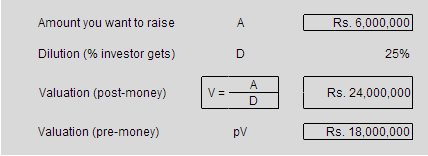
So for instance, if you seek to raise Rs. 60 Lakhs (Rs 6 million) and desire to dilute no more than 25%, then your post-money valuation is

Valuation

Just as easily for the same money, if you have dilute more – your valuation could change without any real material change in your business. Depends how desperate you are and how greedy or generous the investor is. The table below shows the effect of A and D on valuations.

Valuation options

Reality rarely is this clean. Happy hunting.

Enhanced by Zemanta

Why I Tell Indian Entrepreneurs “Stop reading TechCrunch!”

Every time I hear an entrepreneur in India tell me “It’s Angel List meets GitHub” I try not to grimace. Given the ardor of youth and the desire to get their elevator pitches easily understood, I can certainly understand young entrepreneurs pitching in such a manner.

TechCrunch (Alexa score 369) is more popular than livemint.com, India’s #2 biz paper (837) or nextbigwhat.com (640) and yourstory.in (802) – two popular Indian startup destinations. At one level just as the BBC (112), Huffington Post (264) and New York Times (305) are popular in India, it’s not a big surprise that TechCrunch given its brand and Silicon Valley pedigree is followed closely and devoured by the tech startup community in India. However the fact that something is understandable doesn’t make it healthy (as with my Doritos-eating habit).

Silicon Valley, even within the context of the United State is in many ways unique – and unlike anything in India. From the time Fredrick Terman first began molding young minds at Stanford, more than three-quarters of a century has passed before Instagram, Twitter and Facebook appeared on the scene. And before them came the first generation Internet folks – the networking and computing folks before them and the granddaddy semiconductor firms before them, who were themselves preceded by the likes of Hewlett-Packard and Litton. So nearly five distinct generations of companies and innovation preceded this current crop.

Alas, ​young Indian founders approach TechCrunch without any of this context. For most of them, 2005 when I sold my first tech startup, is practically the dark ages and 1999 another geological era altogether.

As an angel and mentor when I encounter entrepreneurs, I find that TechCrunch plays an inordinate role today in their thought process. This is true particularly with startups dealing with bits rather than atoms.

Many of their assumptions are not grounded in the reality of today’s India – may not even in today’s America.

All they see is that a startup to sell tampons online raised $250K with just an idea on a napkin. Or Pinterest raised whatever astronomical amount of money without any real monetization strategy and Fred Wilson invested in Zemanta (who’d by then acquired a million downloads) even whilst acknowledging that none of them were clear how they’d make money.

The reality of the Indian entrepreneurial ecosystem is that we are yet to see more than one turn or “generation” of tech entrepreneurs. A large amount of money is following very few quality deals. The VCs are acting as PE players would elsewhere. Angel groups are acting like VCs would. Everyone’s looking for revenue, customers, and traction (all of which are good), but not quite the high risk/high reward perspective of early stage funders. To be fair to the funding community in India, the supply side problem of deal quality is compounded by the fact that there have been very few exits, and their LPs may be looking for medium risk/medium returns.

The needs of the Indian market and Indian consumers are quite distinct. Enterprises in India do have needs similar to those of companies elsewhere – databases, analytical tools, HR software, CRM systems – but their behavior and culture often are different. Consumers, on the other hand, can and do have very different needs. So when we talk about “building the Amazon or Zappos of India,” and unimaginatively try reproducing something done elsewhere, it serves no one well.

The good news is that oodles of young entrepreneurs are starting companies each day in India. Now if only they paid a whole lot more attention to what their customers are saying and what problems those customers face than what TechCrunch is reporting from the Valley, I’d like to think, we’d see a whole lot more innovation and business building amongst Indian entrepreneurs.

© 2026 K Srikrishna

Theme by Anders NorenUp ↑